The Gap Between Writing Code and Running It — Is Costing You
Software delivery should not feel like a relay race where the baton gets dropped every time it crosses the boundary between development and operations. Yet for many engineering organisations, that is exactly what happens. Releases are manual, infrequent, and nerve-wracking. Environments drift because infrastructure is configured by hand. Security is bolted on at the end rather than built in from the start. And when something breaks in production, finding the cause takes longer than fixing it.
Kawach Technology works with engineering teams and technology leaders to close that gap. Our DevOps and platform engineering practice helps organisations build the tooling, processes, and culture that make continuous, reliable software delivery possible — not as a goal for someday, but as the way work actually gets done. We have delivered DevOps transformations for fast-growing SaaS companies, established enterprises modernising legacy delivery pipelines, and everything in between — across North America, Europe, the Middle East, and Asia-Pacific.
What We Deliver
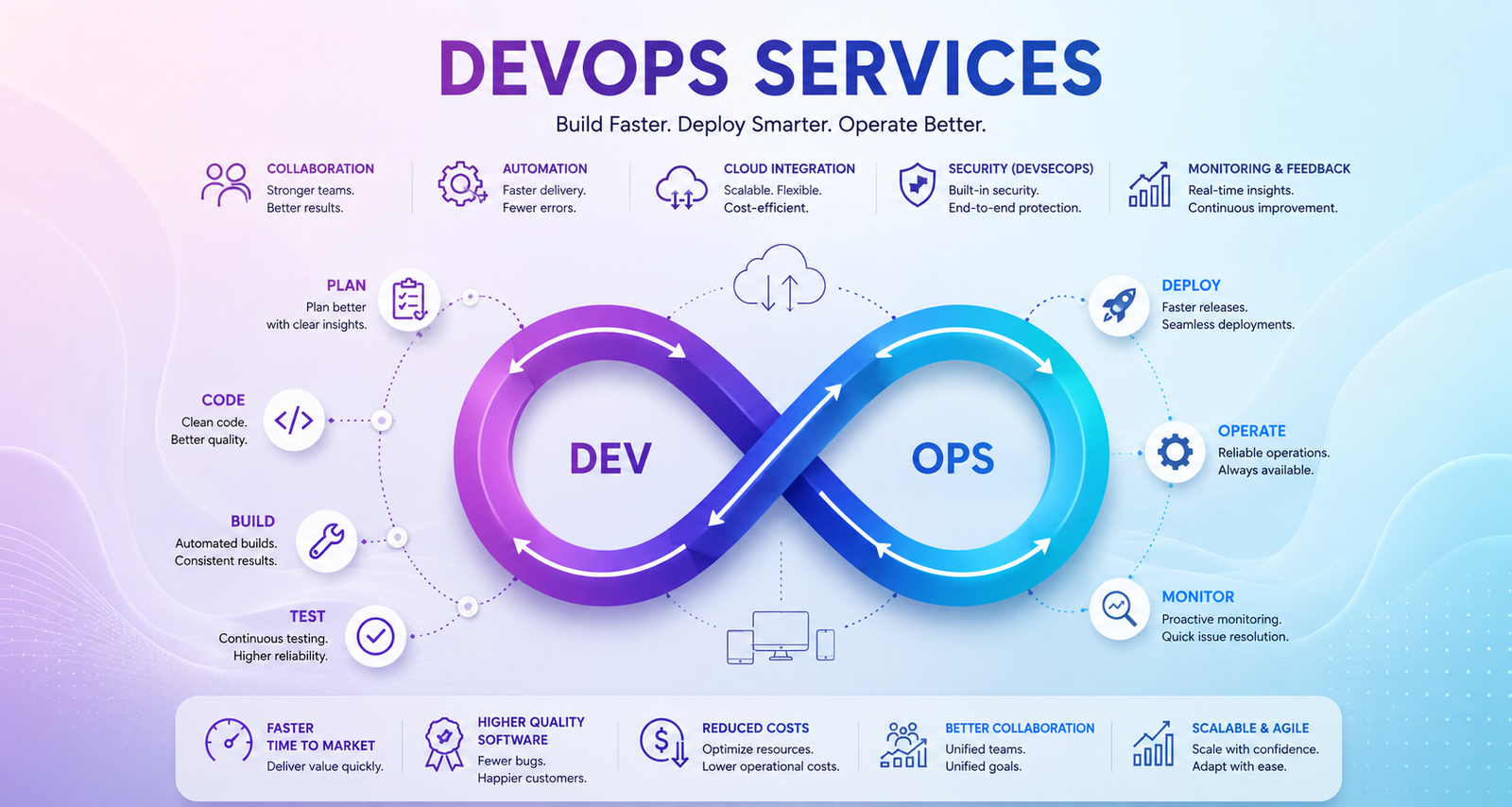
DevOps is not a tool or a job title — it is a set of engineering practices that, implemented well, fundamentally change how software is built, deployed, and operated. Our practice covers the full spectrum:
- CI/CD Pipeline Engineering — Design and build continuous integration and continuous delivery pipelines that automate testing, build, and deployment workflows — reducing manual intervention and making every commit a potential production release.
- Infrastructure as Code (IaC) — Replace manually managed infrastructure with version-controlled, repeatable, auditable code using Terraform, Pulumi, AWS CDK, or platform-native tooling.
- Container & Orchestration Platform Engineering — Containerise applications with Docker and design Kubernetes-based orchestration platforms that scale reliably and operate predictably at any size.
- Cloud Platform Engineering — Design and build internal developer platforms on AWS, Azure, or GCP — including account structure, networking, IAM, and the self-service tooling that lets engineering teams move fast without creating operational chaos.
- DevSecOps Integration — Embed security scanning, secrets detection, dependency auditing, and compliance checks directly into the delivery pipeline — finding vulnerabilities at commit time rather than at penetration test time.
- Site Reliability Engineering (SRE) Practices — Establish SLI/SLO frameworks, error budgets, incident response runbooks, and on-call practices that bring engineering discipline to production operations.
- Observability & Monitoring Architecture — Build the logging, metrics, tracing, and alerting infrastructure that gives engineering teams genuine visibility into how systems behave — in staging and in production.
- GitOps & Release Management — Implement GitOps workflows that make infrastructure and application state declarative, auditable, and automatically reconciled — reducing configuration drift and deployment errors.
Engineering Problems We're Brought In to Solve
The specific problems vary by organisation, but the patterns are familiar:
- Releases that happen quarterly because the deployment process is too fragile and manual to run more frequently
- Development, staging, and production environments that behave differently — making 'it works on my machine' a standing joke with real consequences
- Infrastructure provisioned through the console by whoever had time, with no documentation, no repeatability, and no audit trail
- Security vulnerabilities discovered by external pen testers that should have been caught weeks earlier in the development cycle
- Incident response that relies on tribal knowledge rather than runbooks — where only two people actually know how to recover a critical service
- Cloud costs growing faster than the business because nobody owns capacity planning and over-provisioning is the default safety net
- Engineers spending significant time on operational toil — manual deployments, environment resets, and repetitive configuration work — instead of building product
- New engineers taking months to become productive because the development environment setup is undocumented and fragile
These are structural problems that individual heroics and better intentions will not fix. They require deliberate engineering — and that is what Kawach provides
Our Approach to DevOps Engagements
We begin every engagement with a delivery pipeline and platform audit — an honest assessment of how software currently moves from commit to production, where the friction points are, and what the highest-value improvements look like for this specific organisation. We do not apply a generic DevOps template. What works for a ten-person startup deploying a monolith is different from what a two-hundred-engineer platform team needs.
From audit findings, we build a prioritised roadmap and work iteratively — delivering improvements in short cycles so your engineering team sees real gains quickly rather than waiting for a six-month transformation project to complete. We work alongside your team, not in isolation from it, which means knowledge transfers as we build — so the capability stays in-house when the engagement ends.
We are opinionated about engineering practices but pragmatic about tooling. If your team already has investment in a particular CI platform or cloud provider, we build around that reality rather than starting from scratch. The goal is the best outcome for your organisation, not a showcase of our preferred tools.
Core Capabilities
- Automated Build, Test & Deploy — End-to-end pipeline automation covering code compilation, unit and integration testing, artefact creation, environment promotion, and production deployment — with full rollback capability at every stage.
- Multi-Environment Pipeline Management — Consistent, code-defined environment configurations across development, staging, QA, and production that eliminate environment drift and make 'it worked in staging' a reliable statement.
- Zero-Downtime Deployment Strategies — Blue-green deployments, canary releases, and feature flag integration that allow new versions to be rolled out progressively — and rolled back instantly if metrics degrade.
- Self-Service Developer Platforms — Internal developer platforms with standardised service templates, one-command environment provisioning, and integrated tooling that let product engineers ship independently without waiting on ops.
- Cost & Resource Optimisation — Right-sizing analysis, auto-scaling configuration, spot/preemptible instance strategies, and resource tagging frameworks that bring engineering discipline to cloud spend.
- Disaster Recovery & Business Continuity — Documented, tested recovery procedures with defined RTO and RPO targets — validated through regular game days rather than discovered during an actual incident.
- Pipeline Security Scanning — SAST, DAST, container image scanning, dependency vulnerability checks, and secrets detection integrated as pipeline gates — blocking insecure code from reaching production automatically.
- Compliance as Code — Policy enforcement and compliance checks automated at the infrastructure and pipeline level for SOC 2, ISO 27001, PCI-DSS, HIPAA, and other frameworks — audit evidence generated automatically.
Technology Expertise
- CI/CD Platforms: GitHub Actions · GitLab CI/CD · Jenkins · CircleCI · Buildkite · ArgoCD · Flux
- Infrastructure as Code: Terraform · Pulumi · AWS CDK · Ansible · Crossplane
- Container & Orchestration: Docker · Kubernetes · Helm · Kustomize · Amazon EKS · Azure AKS · Google GKE
- Cloud Platforms: Amazon Web Services (AWS) · Microsoft Azure · Google Cloud Platform (GCP)
- Observability: Prometheus · Grafana · Datadog · New Relic · OpenTelemetry · ELK Stack · Jaeger
- Security & Compliance: Snyk · Trivy · Checkov · HashiCorp Vault · AWS Secrets Manager · OPA / Gatekeeper
- GitOps & Release: ArgoCD · Flux · Spinnaker · Atlantis · Backstage
- Scripting & Automation: Python · Bash · Go · Makefile · GitHub Actions workflows
- Service Mesh & Networking: Istio · Linkerd · Envoy · AWS App Mesh · Nginx · Traefik
DevSecOps — Security That Moves at Development Speed
The traditional model of security review at the end of the release cycle does not work at modern delivery speeds. By the time a vulnerability is discovered in a code review or penetration test, it may have existed in the codebase for months and propagated across multiple services.
Our DevSecOps practice shifts security left — integrating automated security checks directly into the development workflow so vulnerabilities are caught at commit time, not at release time. This includes:
- Static application security testing (SAST) on every pull request
- Software composition analysis (SCA) for third-party dependency vulnerabilities
- Container image scanning before every deployment to any environment
- Infrastructure as Code security scanning to catch misconfigured cloud resources before provisioning
- Secrets detection to prevent credentials, API keys, and tokens from entering the codebase
- Runtime security monitoring for anomalous behaviour in production workloads
- Automated compliance evidence collection for audit readiness
Platform Engineering for Scale
There is a meaningful difference between DevOps tooling and a genuine internal developer platform. Tooling is a collection of scripts and CI jobs. A platform is a coherent, product-managed environment that abstracts infrastructure complexity away from application teams — letting them deploy, scale, and observe their services without needing deep platform expertise.
As engineering organisations grow, ad-hoc DevOps tooling becomes a bottleneck. Every new team reinvents the same pipeline patterns. Infrastructure becomes inconsistent. Onboarding takes months. Kawach designs and builds internal developer platforms that scale — with golden path templates, self-service capabilities, and the kind of developer experience that keeps engineering velocity high as headcount grows.
Observability & Production Reliability
You cannot operate what you cannot observe. Many organisations have monitoring in place — but there is a significant difference between having dashboards and having genuine observability. True observability means being able to ask arbitrary questions about system behaviour and get answers from telemetry data, without needing to instrument new code every time something unexpected happens.
Kawach builds observability architectures grounded in the three pillars — metrics, logs, and distributed traces — integrated into a coherent operational view. We establish SLI/SLO frameworks that give engineering teams a principled way to make decisions about reliability versus feature velocity. And we build the alerting and runbook infrastructure that makes incident response faster and more consistent.
Business & Engineering Benefits
- Higher Deployment Frequency — Organisations with mature CI/CD pipelines and automated testing deploy orders of magnitude more frequently than those without. More frequent releases mean smaller changes, lower risk, and faster feedback from real users.
- Reduced Mean Time to Recovery — When incidents happen, the difference between a fifteen-minute recovery and a four-hour outage often comes down to the quality of observability, runbooks, and tooling. We build the infrastructure that makes recovery fast.
- Lower Cost of Change — Automated testing and deployment removes the manual overhead from every release. Infrastructure as code eliminates repetitive provisioning work. The engineering team spends time building, not managing.
- Consistent, Auditable Infrastructure — Version-controlled infrastructure means every environment is reproducible, every change is traceable, and drift between environments is detectable and correctable — not discovered during incidents.
- Engineering Team Productivity — A well-designed internal platform removes the toil that frustrates senior engineers. Faster onboarding, self-service environments, and reliable pipelines mean the engineering organisation moves faster without growing headcount proportionally.
- Quantifiable Security Posture — Automated pipeline security gates and compliance checks produce measurable, auditable evidence of security practices — useful for customer audits, SOC 2 certification, and executive reporting.
- Industries We Serve
- SaaS & Technology — High-frequency release pipelines, multi-tenant infrastructure, feature flag systems, and developer platform engineering for growing product teams
- Financial Services & Fintech — Compliance-aligned CI/CD, change management automation, security-hardened pipelines, and audit evidence generation for regulated environments
- Healthcare & Life Sciences — HIPAA-compliant infrastructure automation, validated deployment processes, and platform engineering for clinical and digital health applications
- E-Commerce & Retail — High-availability deployment strategies, traffic management, performance testing integration, and cost-optimised cloud infrastructure for commerce platforms
- Media & Content Platforms — CDN automation, content delivery pipeline engineering, auto-scaling infrastructure for variable traffic patterns
- Enterprise Software & ISVs — Multi-environment release management, customer deployment automation, SaaS delivery infrastructure, and white-label platform tooling
Why Engineering Teams Choose Kawach
- We are engineers first — we build and operate the tooling we recommend, rather than advising from a distance
- Embedded engagement model: our engineers work directly with your team, not in a separate workstream
- We design for knowledge transfer from day one — so capability stays in your organisation when the engagement ends
- Opinionated about practices, pragmatic about tools — we build on your existing investment where it makes sense
- Delivery track record across complex, regulated, and high-scale environments where the stakes are real
- We measure success by engineering outcomes — deployment frequency, change failure rate, MTTR — not by deliverables delivered
- Global delivery capability with experience across AWS, Azure, and GCP governance requirements in multiple regions
Platform Engineering for the Decade Ahead
The conversation has evolved from DevOps to platform engineering — and the organisations investing in genuine internal developer platforms today are building a durable competitive advantage. When application teams can provision environments, deploy services, and observe production behaviour without operational friction, the entire organisation moves faster.
Kawach builds with that trajectory in mind. Whether that means designing a Backstage-powered developer portal, building a platform engineering team from scratch, or progressively modernising an existing delivery pipeline — we help engineering organisations build the platform capabilities that will still be serving them five years from now.
Ready to Modernise Your Delivery Pipeline?
If your engineering team is spending more time managing releases than building product, or your infrastructure has grown faster than your ability to govern it, a focused DevOps engagement with Kawach is likely the highest-leverage investment your engineering organisation can make.
We start with a delivery pipeline audit — a structured, two-to-three day assessment that gives you a clear picture of where your current pipeline stands, what the highest-value improvements are, and what a realistic roadmap looks like. No long proposals, no commitments required.