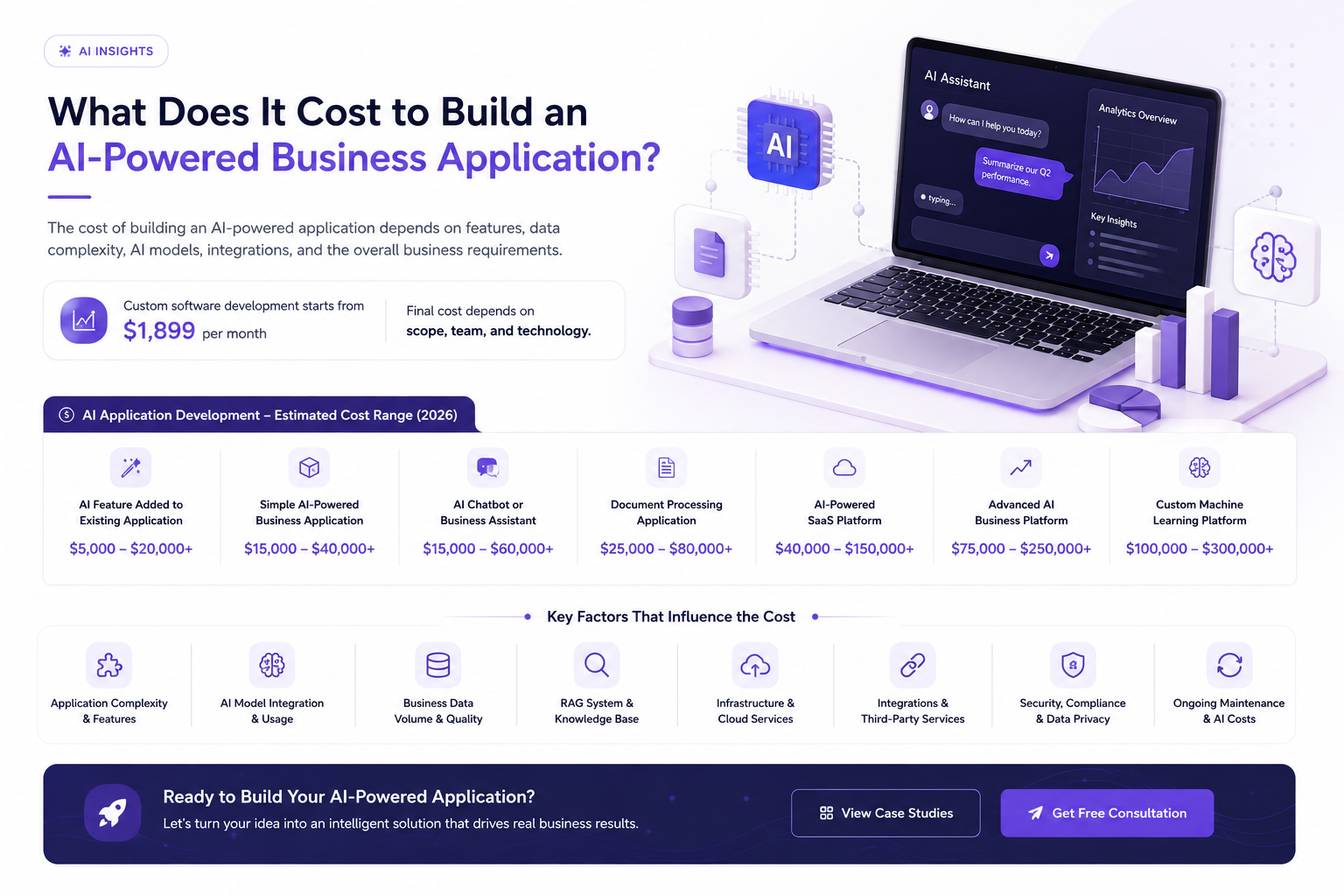
What Does It Cost to Build an AI-Powered Business Application?
AI has moved from something businesses experimented with to something they're actively trying to put into their products.
A company might want an AI assistant for its support team. Another might want employees to search internal documents using natural language. A healthcare company may want automated document processing. An e-commerce business might want recommendations or smarter customer support.
All of these can be called "AI-powered applications."
But they don't cost the same to build.
Adding an AI feature to an existing business application can be relatively straightforward. Building a complete AI platform with custom workflows, document processing, user management, integrations, analytics, security, and a scalable backend is a completely different project.
So, what does it actually cost to build an AI-powered business application in 2026?
A realistic answer depends on what the application needs to do.
For businesses looking for a flexible development model, Kawach Technology offers custom software development starting at $1,899 per month. The final development budget depends on the scope, team, technology, AI requirements, and infrastructure involved.
Let's break down where the money actually goes.
How Much Does an AI-Powered Business Application Cost?
There is no single price for an AI application.
As a general planning guide:
Type of AI ApplicationApproximate Development RangeAI feature added to an existing application$5,000 – $20,000+Simple AI-powered business application$15,000 – $40,000+AI chatbot or business assistant$15,000 – $60,000+Document processing application$25,000 – $80,000+AI-powered SaaS platform$40,000 – $150,000+Advanced AI business platform$75,000 – $250,000+Custom machine learning platform$100,000 – $300,000+
These numbers are planning ranges, not fixed quotations.
The actual budget can be much lower or higher depending on the product.
For example, using an existing AI model through an API is very different from training and maintaining a specialized machine-learning model.
Why Is AI Application Development Difficult to Price?
The phrase "AI application" covers a huge range of products.
Consider these two projects.
Project A: AI Customer Support Assistant
A company wants an assistant that:
- Answers customer questions
- Uses company documentation
- Creates support tickets
- Escalates difficult questions
- Connects to the company's CRM
This might use an existing AI model, a knowledge base, APIs, and a normal web application.
Project B: AI-Powered Business Intelligence Platform
Another company wants software that:
- Processes millions of records
- Detects patterns
- Generates forecasts
- Produces reports
- Uses custom machine-learning models
- Provides real-time dashboards
- Integrates with multiple business systems
Both projects involve AI.
The development effort, infrastructure, data requirements, testing, and ongoing costs are completely different.
That's why a useful AI development estimate starts with the business problem, not simply the word "AI."
What Actually Makes an AI Application Expensive?
The AI model is only one part of the project.
Several other components can make up most of the development effort.
1. Business Application Development
An AI feature still needs a real application around it.
That application may include:
- User registration
- Authentication
- User roles
- Admin dashboards
- Billing
- Notifications
- Reports
- APIs
- File uploads
- Search
- Settings
- Audit logs
For example, an AI assistant used by employees still needs accounts, permissions, conversation history, document management, and an interface.
The AI is one component of the product.
2. AI Model Integration
Many business applications don't need a model trained from scratch.
They can use an existing model through an API.
The application sends information to the model, receives the response, and then uses that response inside the business workflow.
This can significantly reduce development complexity.
The cost can increase when you need:
- Multiple models
- Specialized prompts
- Structured outputs
- Function calling
- Tool use
- Model routing
- Custom inference
- Fine-tuning
- Evaluation systems
3. Your Business Data
This is one of the parts people often underestimate.
An AI system is only useful if it can work with the information relevant to the business.
That may include:
- PDFs
- Word documents
- Product information
- Customer records
- Internal policies
- Knowledge bases
- Emails
- Databases
- Support tickets
Making this information usable by AI can require document processing, extraction, indexing, search, permissions, and data pipelines.
RAG Can Add Another Layer
Many businesses don't actually need to train their own AI model.
Instead, they can use Retrieval-Augmented Generation (RAG).
The basic idea is fairly straightforward:
A user asks a question.
The system searches the company's relevant information.
The most relevant information is provided to the AI model.
The model then generates an answer based on that context.
For example, an employee could ask:
"What is our refund policy for enterprise customers?"
The application can search the company's internal documentation and provide the relevant information to the AI model before generating the response.
Building this properly involves more than connecting an API.
You may need:
- Document ingestion
- Text extraction
- Chunking
- Embeddings
- Vector search
- Metadata
- Access control
- Retrieval logic
- Response generation
- Evaluation
That is where an apparently simple AI feature can become a real software project.
4. AI Usage Costs
Development isn't the only expense.
AI applications can have ongoing usage costs.
Depending on the architecture, you may pay for:
- Model API usage
- Embeddings
- Vector databases
- Cloud computing
- File storage
- Data processing
- Monitoring
- Logging
The cost depends heavily on usage.
An internal application used by 20 employees will have very different AI usage from a consumer application serving 500,000 users.
That's why AI infrastructure should be planned around expected usage rather than simply choosing the most powerful model available.
5. Custom Machine Learning
There is a big difference between using an existing AI model and building a custom machine-learning system.
If an existing model can solve the problem, using it can save substantial development time.
Custom machine learning may require:
- Data collection
- Data cleaning
- Labeling
- Feature engineering
- Model development
- Training
- Evaluation
- Deployment
- Monitoring
- Retraining
This can make the project significantly more expensive.
Custom ML makes sense when the business has a specific problem that general-purpose models cannot solve adequately.
6. Integrations
Business applications rarely operate alone.
An AI application might need to connect with:
- CRM
- ERP
- Payment gateways
- Accounting software
- Cloud storage
- Internal databases
- Customer support systems
- Marketing platforms
- Mobile applications
Every integration adds development and testing work.
It can also introduce ongoing maintenance because third-party APIs can change.
7. Security and Permissions
AI introduces some security questions that traditional applications don't always have.
For example:
Should every employee be able to ask the AI about every company document?
Probably not.
An AI system working with internal information may need permission-aware retrieval.
A finance employee might have access to financial documents that a sales employee shouldn't see.
That means access control needs to be considered throughout the AI workflow.
Other considerations can include:
- Authentication
- Authorization
- Data encryption
- API security
- Audit logging
- Secure file storage
- Sensitive data handling
- Prompt injection protection
- Monitoring
Security requirements can therefore affect both development and infrastructure costs.
AI Application Cost by Feature
Another useful way to estimate an AI project is to look at individual features.
AI FeatureRelative Development ComplexityAI text generationLow to mediumAI chatbotMediumDocument summarizationMediumAI searchMediumRAG knowledge assistantMedium to highDocument extractionMedium to highAI recommendationsHighPredictive analyticsHighComputer visionHighCustom machine learningVery high
These categories aren't absolute.
A simple chatbot can become a complex system when it needs multiple data sources, permissions, workflows, analytics, and integrations.
Build an AI Feature or Build an AI Product?
This distinction can dramatically change the budget.
Adding AI to Existing Software
Suppose you already have a CRM.
You want to add:
- AI-generated email replies
- Lead summaries
- Customer sentiment analysis
- Automated notes
You may not need to build an entirely new application.
The AI can become another layer inside the existing system.
This can be considerably more efficient.
Building a New AI Product
Now imagine you're building a SaaS platform where AI is the main product.
You may need:
- User accounts
- Subscriptions
- Billing
- AI workflows
- Prompt management
- Usage tracking
- Model selection
- File processing
- Knowledge bases
- Analytics
- Admin controls
- APIs
- Security
- Monitoring
That's a much larger development project.
What Technology Should You Use?
There isn't one technology stack that works for every AI application.
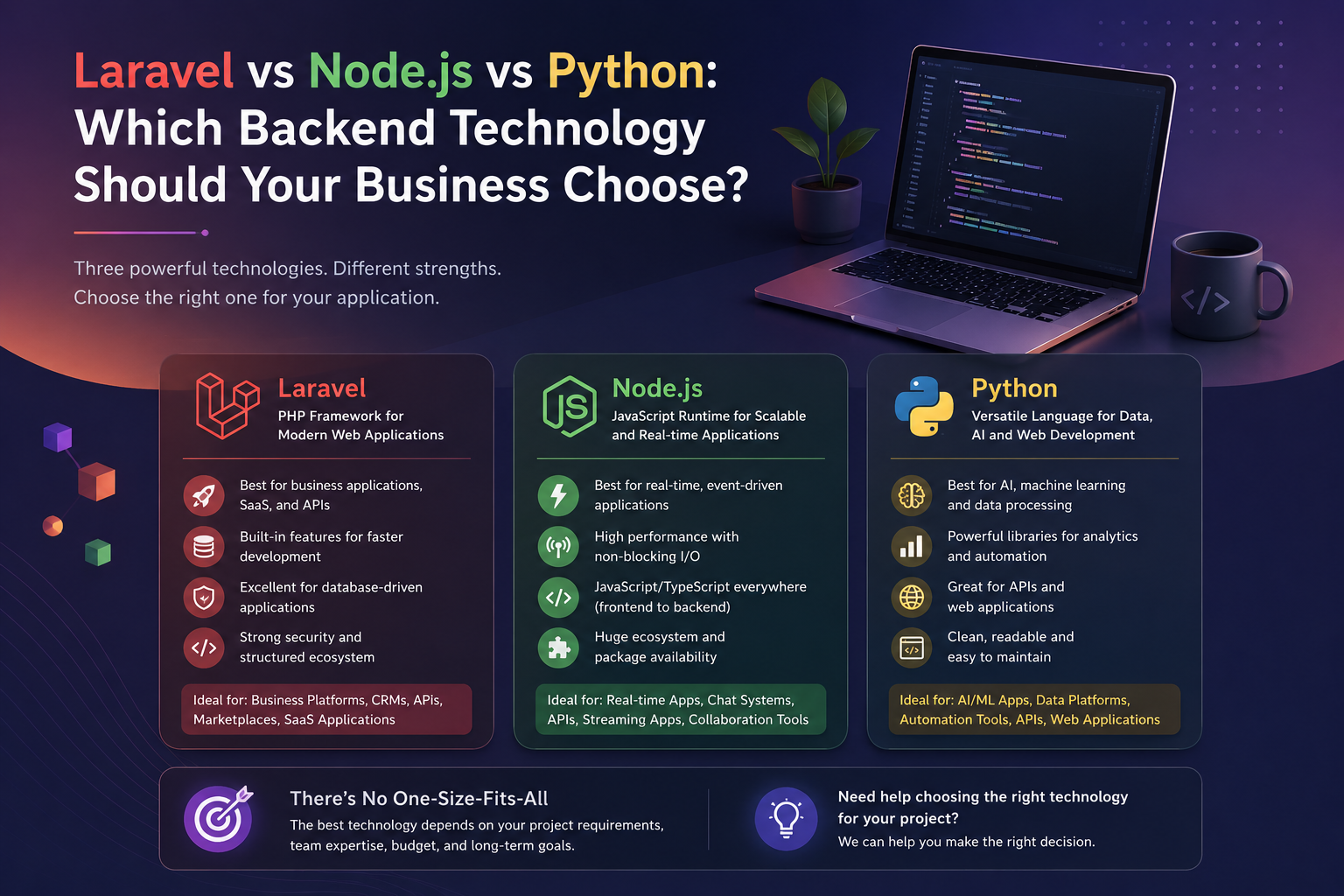
A typical business application might use Laravel, Node.js, or another backend for the core application.
Python is particularly useful when the application involves machine learning, data processing, or specialized AI services.
A possible architecture could look like:
Web/Mobile Application → Backend API → AI Service → AI Model
For example:
- Laravel handles business logic and authentication.
- React handles the web interface.
- Python handles AI processing.
- A database stores application data.
- Cloud infrastructure handles deployment and scaling.
Another project may use Node.js throughout the backend and connect directly to AI APIs.
The architecture should follow the application's requirements.
How Long Does It Take to Build an AI Application?
Again, there is no universal timeline.
A basic AI feature might take a few weeks.
A focused MVP might take a few months.
A larger AI-powered SaaS platform can take six months or longer.
The timeline depends on:
- Number of features
- AI complexity
- Data preparation
- Integrations
- UI/UX
- Security
- Testing
- Team size
- Infrastructure
Trying to rush an AI product can also create problems later.
The first version should be focused enough to launch, but the underlying architecture should not make future improvements unnecessarily difficult.
How to Reduce AI Development Costs
You don't necessarily need to spend hundreds of thousands of dollars to start using AI.
There are several ways to control the budget.
Start With One Valuable Use Case
Don't add AI everywhere just because you can.
Choose one problem where AI can provide measurable value.
For example:
Instead of: "Let's build an AI-powered business platform."
Start with:
"Let's reduce the time our support team spends answering repetitive questions."
That's easier to measure and much easier to build.
Use Existing AI Models
If an existing model solves the problem, you may not need to build your own.
This can dramatically reduce the initial development effort.
Build an MVP
Your first version might only need:
- User authentication
- One AI workflow
- Basic dashboard
- Usage tracking
- Simple administration
Once users start using it, you can decide which features deserve further investment.
Don't Overbuild the Infrastructure
You don't necessarily need a complicated distributed architecture on day one.
Build infrastructure around your actual usage and expected growth.
Then scale it as the product proves itself.
What About AI Maintenance?
Launching the application isn't the end of the project.
AI systems can require ongoing work.
You may need to:
- Monitor responses
- Improve prompts
- Update models
- Manage API changes
- Improve retrieval
- Add new documents
- Fix application bugs
- Monitor infrastructure
- Control AI usage costs
- Improve security
This is particularly important for business applications where incorrect AI responses can have real consequences.
Regular application maintenance can help keep the software reliable as both the business and AI ecosystem change.
Why Choose Kawach Technology for AI-Powered Applications?
Kawach Technology helps businesses build custom software and integrate modern AI capabilities into business applications.
Depending on the project, the development team can work across:
- Laravel
- PHP
- Node.js
- Python
- React
- Vue.js
- Flutter
- React Native
- APIs
- Cloud infrastructure
- AI integrations
- Data processing
- DevOps
- QA and testing
This allows the technology stack to be selected around the product instead of forcing every project into the same architecture.
For businesses looking for a flexible development model, Kawach custom software development starts at $1,899 per month.
The actual cost depends on the application scope, AI requirements, integrations, development resources, and infrastructure.
Frequently Asked Questions
1. How much does it cost to build an AI-powered business application?
The cost can range from around $15,000 for a relatively simple AI application to well over $100,000 for a complex AI platform. The final cost depends on the features, AI architecture, integrations, data requirements, security, and development team.
2.Is it cheaper to use an existing AI model?
Usually, using an existing AI model through an API can reduce development complexity compared with creating and training a custom model. Whether it is cheaper overall depends on usage, functionality, data requirements, and the level of customization needed.
3.Do I need to build my own AI model?
Not necessarily. Many business applications can use existing AI models. Custom machine learning becomes more relevant when existing models cannot provide the accuracy, specialization, or control your application requires.
4.How much does an AI chatbot cost to build?
A basic AI chatbot can be relatively affordable, while a business chatbot connected to internal documents, CRM data, user permissions, ticketing systems, analytics, and multiple workflows can become a much larger project.
5.Can AI be added to existing business software?
Yes. AI can often be integrated into an existing application rather than replacing the entire system. Examples include automated summaries, document analysis, AI search, recommendations, content generation, and customer support assistants.
6.Does an AI application require Python?
No. Python is widely used for AI and machine learning, but an AI application can use Laravel, Node.js, or other technologies for its main backend. Python can be used as a separate AI service when needed.
7.How long does an AI application take to build?
A small AI feature may take weeks, while an MVP can take a few months. Larger AI-powered SaaS and enterprise applications may require six months or longer depending on their complexity.
8.How much does Kawach custom software development cost?
Kawach custom software development starts at $1,899 per month. The final cost depends on the development scope, team requirements, AI functionality, integrations, infrastructure, and ongoing support.
Final Thoughts
The cost of an AI-powered business application isn't determined by the AI model alone.
The bigger picture includes the application around the AI, the data it needs to access, integrations, security, infrastructure, user experience, testing, and ongoing maintenance.
That's why two companies can both say they're building an "AI application" while having completely different budgets.
If you're starting from scratch, don't begin by asking:
"How much does AI software cost?"
Start with:
"What business problem are we trying to solve with AI?"
Once that is clear, it's much easier to decide whether you need an AI API, a RAG system, custom machine learning, automation, or simply a small AI feature inside your existing application.
For businesses that want to build gradually, Kawach Technology offers custom software development starting at $1,899 per month, giving you the option to develop the product in stages instead of trying to build everything at once.
The smartest AI projects aren't necessarily the ones with the most AI features.
They're the ones where AI solves a real problem, fits naturally into the existing workflow, and creates measurable value for the business.
Be the first to comment.