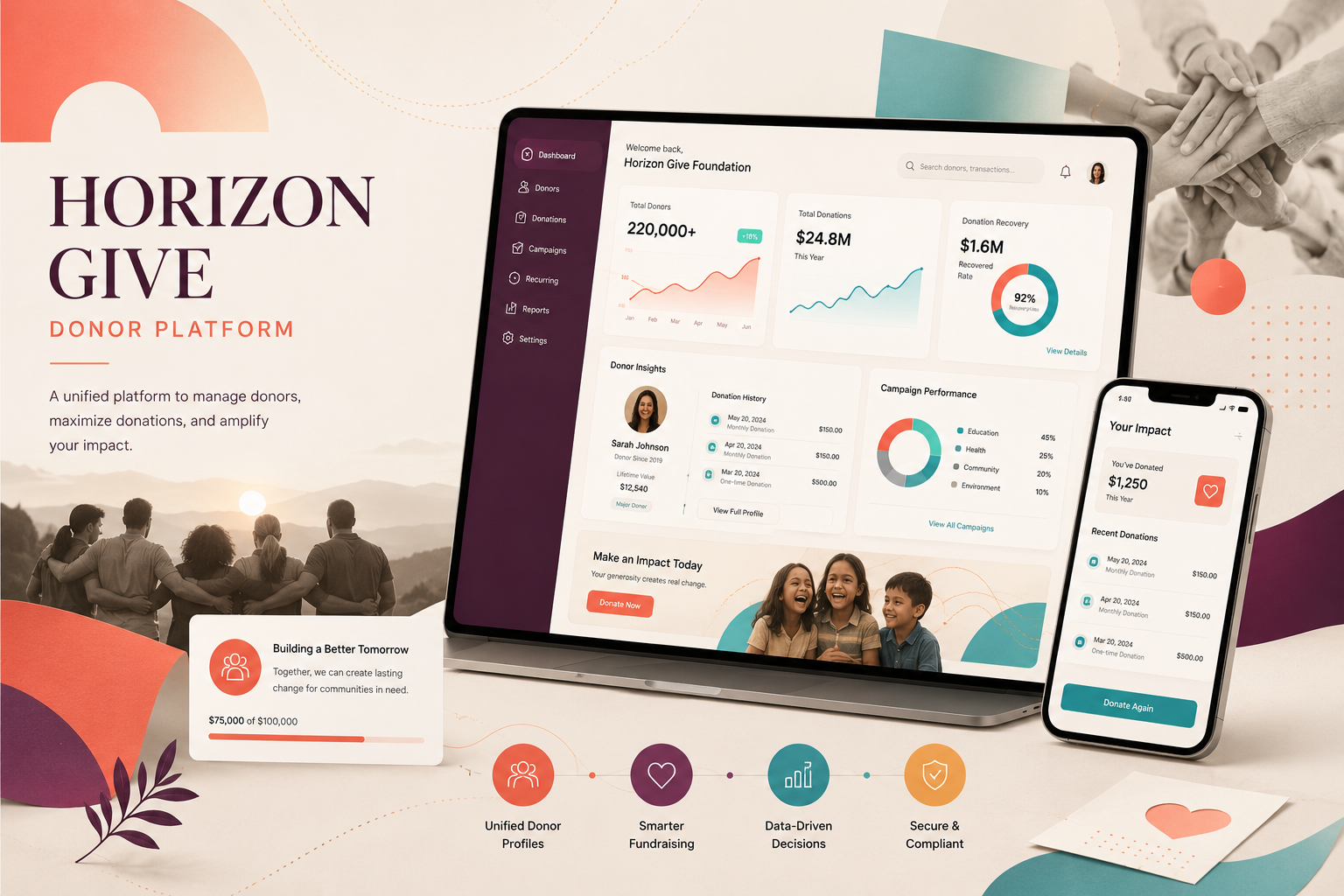
How Kawach Technology unified donor data and automated recurring-donation recovery for Horizon Give Foundation's 220,000+ donors.
Horizon Give Foundation has built a donor base of more than 220,000 people over its history, but that history was part of the problem: donor records were split across an aging CRM, assorted spreadsheets maintained by different staff over the years, and a separate online donation tool that had never been properly connected back to anything else. A single donor's giving history might be scattered ac...
Horizon Give Foundation has built a donor base of more than 220,000 people over its history, but that history was part of the problem: donor records were split across an aging CRM, assorted spreadsheets maintained by different staff over the years, and a separate online donation tool that had never been properly connected back to anything else. A single donor's giving history might be scattered across all three, with no one system showing the complete picture.
Recurring monthly donations — the backbone of any sustainable nonprofit's revenue — had a quietly high silent failure rate. Expired cards and other routine payment failures caused donations to simply stop, with no automated process to reach out and recover them; a donor who wanted to keep giving might simply fall off without anyone noticing until someone happened to run a report.
Compiling donor and impact reports for grant applications and board meetings took the development team days each time, since the data lived in three places and had to be reconciled manually. There was no way to segment donors for targeted outreach beyond a few broad, manually maintained mailing lists, and major donor relationship history — the kind of detail that actually matters for cultivating a significant gift — was tracked informally, often living only in one staff member's inbox and memory.
Consolidating three disconnected data sources into one unified donor CRM was the necessary first step, and also the riskiest — donor giving history is not something a nonprofit can afford to get wrong or lose during a migration. We ran a careful, staged consolidation, reconciling records across all three legacy sources and manually resolving conflicts (like the same donor appearing under slightly different names or addresses) before considering the migration complete.
With clean, unified data in place, we built automated recurring-donation recovery: when a card fails, the system automatically retries on a sensible schedule and, if needed, reaches out to the donor with a simple, low-friction way to update their payment method — recovering donations that used to just quietly stop with nobody noticing.
Reporting automation meant grant and board reports that used to take the development team days now generate in minutes, pulling directly from the unified donor and donation data rather than requiring manual reconciliation across systems. Donor segmentation tools let the team build targeted outreach campaigns based on actual giving behavior and history, rather than the same broad mailing list going to everyone regardless of relevance.
For major donor relationships specifically, we built a relationship-tracking module that captures interaction history, giving patterns, and relevant notes in one place — replacing the "it's in someone's inbox" system with something the whole development team can actually see and act on, which matters a great deal when a key staff member eventually moves on.
Consolidate three disconnected data sources into one donor CRM.
Automatically retry and recover recurring donations that silently fail.
Generate grant and board reports in minutes instead of days.
Segment donors by real giving behavior for more relevant campaigns.
One consolidated record for every donor across all channels.
Automated retry and outreach for failed recurring payments.
Grant and board reports generated on demand.
Targeted outreach based on real giving behavior.
Shared relationship history for significant donors.
A modern, mobile-friendly giving experience.
We selected every technology based on this project's real requirements: compliance obligations, scalability needs, and long-term maintainability. No trend-chasing, only battle-tested solutions.
Agile delivery with regular demos and continuous deployment. Full transparency at every stage.
Mapped donor records across all 3 legacy systems and planned a careful, staged consolidation.
Migrated and reconciled donor records, resolving duplicate and conflicting entries by hand where needed.
Built automated retry and donor outreach for failed recurring payments.
Built self-service grant and board reporting pulling directly from the unified data.
Delivered donor segmentation tools for targeted outreach based on real giving behavior.
Trained the development team across the organization on the new unified system.
Numbers measured at 6 months post-launch, independently verified by the client's operations team.
| Before | After |
|---|---|
| Donor data split across 3 disconnected systems | One unified donor CRM |
| High silent recurring-donation failure rate | Automated recovery reclaiming most lapses |
| Days to compile reports for grants/board | Self-service reports in minutes |
| Broad, manually maintained mailing lists | Targeted, data-driven donor segmentation |
Beyond the numbers: what this project changed day-to-day for Horizon Give Foundation and the people who rely on what we built.
Kawach Technology helps startups and enterprises build scalable, secure, and high-performance digital platforms. Let's turn your vision into the next success story.
Want a similar result for your business? Explore our CRM Development services , or see how we work with businesses in the USA , or get in touch directly.