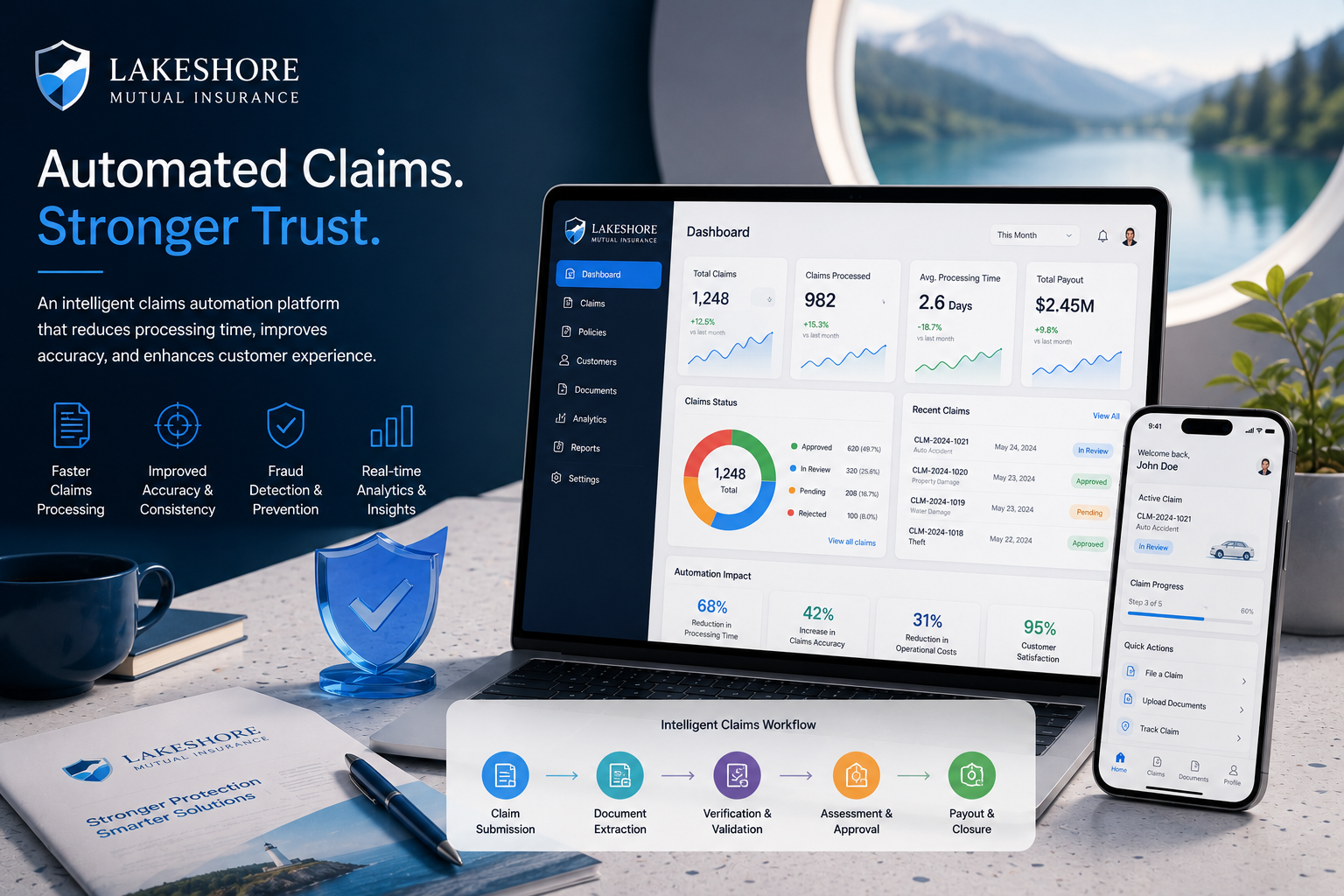
Automating Claims Intake and Triage for Lakeshore Mutual Insurance's 300,000 Policyholders Automating Claims Intake and Triage for Lakeshore Mutual Insurance's 300,000 Policyholders
1 0 1 1 0 0 1 0
0 1 0 0 1 1 0 1
1 1 0 1 0 1 1 0
0 0 1 0 1 0 0 1
Back to Case Studies
Case Study: Property & Casualty Insurance

Automating Claims Intake and Triage for Lakeshore Mutual Insurance's 300,000 Policyholders

How Kawach Technology automated claims intake and fraud detection for Lakeshore Mutual Insurance, cutting response time from 7 days to 4 hours.

Property & Casualty Insurance 10 months Aug 2025
Explore Project
7 days → 4 hrs
Initial Response Time
76%
Digital Filing Adoption
+3.2x
Suspected Fraud Caught Pre-Payout
-38%
Call Center Volume

Client Overview

Lakeshore Mutual Insurance

Lakeshore Mutual Insurance serves more than 300,000 policyholders across the Midwest, but filing a claim in 2024 still meant picking up the phone, sending a fax, or mailing in paperwork — there was no digital self-service option at all. Every claim that came in was manually triaged and assigned to an adjuster by a claims coordinator working through a queue, which alone added days before anyone had...

Industry
Property & Casualty Insurance
Business Size
Regional insurer, 300,000+ policyholders
Location
Chicago, Illinois, USA · Software development in the USA
Business Model
Property & Casualty Insurance
Project Duration
10 months
Existing Challenges
  • Claims could only be filed by phone, fax, or mail, with no digital self-service option.
  • Every claim was manually triaged and assigned to an adjuster, adding days before any actual review began.
  • Policyholders often waited over a week just to hear back after filing a claim.
  • Fraud detection relied entirely on adjuster intuition and after-the-fact audits, with no systematic flagging.
  • Claims status updates required policyholders to call in, adding to already-strained call center volume.
The Challenge

What We Were Up Against

Lakeshore Mutual Insurance serves more than 300,000 policyholders across the Midwest, but filing a claim in 2024 still meant picking up the phone, sending a fax, or mailing in paperwork — there was no digital self-service option at all. Every claim that came in was manually triaged and assigned to an adjuster by a claims coordinator working through a queue, which alone added days before anyone had actually reviewed the claim's substance.

Policyholders routinely waited over a week just to hear back after filing, which is a genuinely difficult experience when the claim in question is often about something stressful — storm damage to a home, a car accident, a burst pipe. Meanwhile, fraud detection relied entirely on adjuster intuition built from experience and after-the-fact audits; there was no systematic way to flag a suspicious claim pattern before the payout had already gone out.

Every status inquiry required a phone call, which meant the call center absorbed a steady stream of "what's happening with my claim" calls that a self-service system could have handled instantly — straining call center capacity and making policyholders wait even to ask a simple question.

Our Solution

How We Built It

We built a digital claims intake portal as the front door to everything else — policyholders can now file a claim online or via mobile in minutes, uploading photos and documentation directly rather than mailing them in. That structured digital intake is what made automated triage possible in the first place: the system now routes each claim to the right adjuster based on claim type, complexity, and current workload, work that used to require a human coordinator manually reading every submission.

Fraud detection was the piece Lakeshore's claims leadership was most cautious about, understandably — false positives that delay a legitimate claim create real harm. We trained a machine-learning model on Lakeshore's own historical claims data, looking for the patterns that had actually preceded confirmed fraud in the past rather than generic industry heuristics, and we ran it in parallel with the claims team's normal process for an extended validation period before it influenced any live triage decision.

Self-service status tracking closed the loop on the call-center problem: policyholders can now check exactly where their claim stands without calling in, which took a meaningful chunk of routine inquiry volume off the phone lines. We rolled the new system out by claim type rather than all at once — starting with simpler, lower-complexity claim categories where automated triage had the clearest track record, before extending to more complex claim types once the team had built confidence in the system's judgment.

Key Modules Delivered
Digital Claims Intake Portal
Online and mobile claims filing with direct photo and document upload.
Automated Triage Engine
Routes claims to the right adjuster based on type, complexity, and workload.
ML Fraud Flagging
A model trained on Lakeshore's own historical claims data to flag suspicious patterns pre-payout.
Adjuster Assignment & Workload Balancing
Balances new claims across adjusters based on current caseload.
Self-Service Status Tracking
Policyholders check claim status anytime without calling in.
Document & Photo Upload
Direct upload of claim evidence from any device.
Goals & Objectives

What Success Looked Like

Enable Digital Claims Filing

Give policyholders a fast, self-service way to file a claim.

Automate Triage & Assignment

Route claims to the right adjuster automatically based on type and complexity.

Flag Potential Fraud Earlier

Catch suspicious claim patterns before payout, not after.

Reduce Call Center Load

Let policyholders self-serve claim status instead of calling in.

Features Developed

What We Built

Digital Claims Portal

File a claim online or via mobile in minutes.

Automated Triage

Claims routed to the right adjuster automatically.

ML Fraud Detection

Suspicious patterns flagged before payout.

Self-Service Status Tracking

Check claim status anytime without calling in.

Adjuster Workload Balancing

New claims distributed based on current caseload.

Mobile Photo/Document Upload

Submit claim evidence directly from any device.

Technology Stack

Built With the Right Tools

We selected every technology based on this project's real requirements: compliance obligations, scalability needs, and long-term maintainability. No trend-chasing, only battle-tested solutions.

Backend
Java Spring Boot PostgreSQL
Fraud Detection
Python scikit-learn
Frontend
React mobile-responsive
Infrastructure
AWS encrypted claims storage
Development Process

How We Delivered It

Agile delivery with regular demos and continuous deployment. Full transparency at every stage.

Total Timeline
10 months
Started → Ongoing
1
01
Claims Workflow Discovery

Mapped the full claims lifecycle from filing through payout across claim types.

2
02
Digital Intake Portal Design

Built the online/mobile filing flow with direct evidence upload.

3
03
Triage & Assignment Automation

Automated adjuster routing based on claim type, complexity, and workload.

4
04
Fraud Model Training

Trained the fraud detection model on Lakeshore's own historical claims data.

5
05
Parallel-Run Validation

Ran automated triage and fraud flagging alongside the existing claims team process before trusting live decisions to it.

6
06
Phased Rollout by Claim Type

Launched with simpler claim categories first, expanding to more complex types as confidence grew.

Security & Compliance

Built for the Strictest Standards

State Insurance Regulatory Compliance
Claims workflows align with Illinois and multi-state insurance regulatory requirements.
Claims Data Encryption
All claims data, including uploaded evidence, is encrypted at rest and in transit.
Fair Claims Practices Compliance
Automated triage and fraud flagging were designed to align with fair claims handling regulations.
Results / KPIs

Measurable Impact

Numbers measured at 6 months post-launch, independently verified by the client's operations team.

7 days → 4 hrs
Initial Response Time
76%
Digital Filing Adoption
+3.2x
Suspected Fraud Caught Pre-Payout
-38%
Call Center Volume

Before vs. After

Before After
Phone/fax/mail-only claims filingDigital self-service filing portal
Manual multi-day triageAutomated triage and adjuster assignment
Fraud caught only after payout, if at allML flagging before payout
Policyholders called in for status updatesSelf-service status tracking
"
A week-long wait just to hear back on a claim is a terrible experience for someone dealing with storm damage or a car accident. Cutting that to about four hours changed how our policyholders feel about us at the exact moment it matters most. And the fraud model catching more than three times what we caught manually, without slowing down legitimate claims, is the kind of result that's easy to sell internally.
PA
Patrick O'Malley
VP of Claims Operations, Lakeshore Mutual Insurance
★★★★★
Key Achievements

Why This Project Matters

Beyond the numbers: what this project changed day-to-day for Lakeshore Mutual Insurance and the people who rely on what we built.

Response Time Cut from a Week to Hours
Initial claims response time dropped from about 7 days to roughly 4 hours.
76% Digital Filing Adoption
More than three-quarters of policyholders now file claims digitally rather than by phone, fax, or mail.
Fraud Detection More Than Tripled
Suspected fraud caught before payout increased 3.2x compared to the prior manual-only process.
FAQ

Common Questions

Have more questions? Book a call with our team.

How do you avoid false positives delaying legitimate claims?
We ran the fraud model in parallel with the claims team's normal process for an extended period, comparing its flags against real outcomes, before letting it influence any live triage decision — and it flags for adjuster review rather than auto-denying anything.
Are adjusters being replaced by the automated system?
No. The system handles triage and routing so adjusters spend their time on actual claim assessment rather than administrative sorting — every claim is still reviewed by a human adjuster.
How does the platform stay compliant across different state insurance regulations?
Claims workflows were built with Lakeshore's compliance team to align with Illinois and neighboring-state insurance regulatory requirements, including fair claims handling rules.
Why was rollout phased by claim type instead of all at once?
Starting with simpler, lower-complexity claims let the team validate the automated triage and fraud flagging track record before extending it to more complex, higher-stakes claim types.
Related Case Studies

More Success Stories

Ready to Get Started?

Looking for Custom Property & Casualty Insurance Software Development?

Kawach Technology helps startups and enterprises build scalable, secure, and high-performance digital platforms. Let's turn your vision into the next success story.

View All Case Studies

Want a similar result for your business? Explore our Enterprise Software Development services , or see how we work with businesses in the USA , or get in touch directly.