Building a Patient Management & Telemedicine Platform for MedCare Health Network Building a Patient Management & Telemedicine Platform for MedCare Health Network
1 0 1 1 0 0 1 0
0 1 0 0 1 1 0 1
1 1 0 1 0 1 1 0
0 0 1 0 1 0 0 1
Back to Case Studies
Case Study: Healthcare

Building a Patient Management & Telemedicine Platform for MedCare Health Network

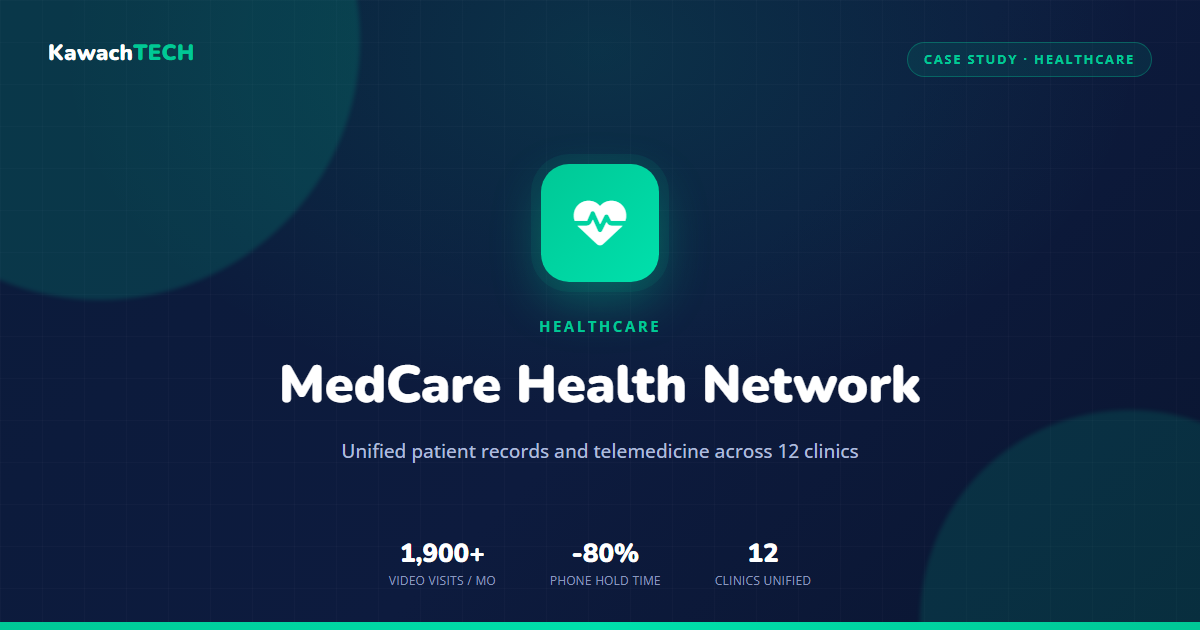
How Kawach Technology unified 12 clinics onto one patient record platform and launched video consultations for MedCare Health Network.

Healthcare 9 months Mar 2026
Explore Project
< 60 sec
Avg. Appointment Booking Time
-80%
Phone Hold Time Reduction
1,900+
Monthly Video Consultations
~20 min/day
Doctor Time Saved on Record Lookup

Client Overview

MedCare Health Network

MedCare Health Network operates 12 clinics across Mumbai, but for years each clinic ran on a different legacy scheduling tool — some on old desktop software, others on nothing more than a diary and a phone line. The consequence was that patient history simply didn't travel with the patient. If someone visited clinic A for a check-up and then clinic C for a follow-up, the doctor at clinic C had no...

Industry
Business Size
12 clinics, 60+ doctors
Location
Mumbai, India
Business Model
Multi-Specialty Clinic Chain
Project Duration
9 months
Existing Challenges
  • Each of the 12 clinics ran a different legacy scheduling tool, so patient records didn't follow patients between locations.
  • Appointment booking was phone-only, with patients often on hold for 15+ minutes during peak hours.
  • Doctors had no way to consult patients remotely, turning away demand for follow-ups that didn't need an in-person visit.
  • Prescription and lab report history was kept on paper at the clinic where treatment happened, invisible to doctors elsewhere.
  • Patients filled out the same intake form by hand at every single visit, regardless of clinic.
The Challenge

What We Were Up Against

MedCare Health Network operates 12 clinics across Mumbai, but for years each clinic ran on a different legacy scheduling tool — some on old desktop software, others on nothing more than a diary and a phone line. The consequence was that patient history simply didn't travel with the patient. If someone visited clinic A for a check-up and then clinic C for a follow-up, the doctor at clinic C had no idea what had already been prescribed or tested.

Booking an appointment meant calling in, and during peak hours patients routinely sat on hold for over 15 minutes. There was no option at all for a remote consultation — every follow-up, even a simple "how are the new medications working," required an in-person visit, which frustrated patients and quietly turned away demand MedCare could have served. Prescription and lab report history lived on paper at whichever clinic issued it, invisible to any doctor at another location.

Perhaps the most telling symptom of the problem: patients filled out the same intake form by hand, every single visit, regardless of how many times they'd already been seen within the MedCare network. It was a system built around individual clinics, not around the patient — and MedCare's leadership knew that had to change before it started costing them patients to competitors offering a more modern experience.

Our Solution

How We Built It

We began by shadowing front-desk staff and doctors across four representative clinics — a mix of high-volume and smaller locations — to understand how scheduling and record-keeping actually happened day to day, not just how MedCare's leadership assumed it happened. That discovery phase directly shaped the data migration plan: consolidating 12 separate, inconsistent datasets into one unified patient record schema without losing a single patient's history.

The platform we built centers on one unified patient record accessible securely across all 12 clinics, backed by an online appointment engine, a browser-based WebRTC video consultation module, digital e-prescriptions, a lab report portal, and consolidated billing that handles both in-person and video visits. We built the patient record and appointment systems first, since every other module depended on them being solid.

Video consultation was the feature MedCare was most nervous about, so we piloted it with just three doctors over four weeks before opening it network-wide — watching closely for call quality issues and gathering doctor feedback on the interface. Once that pilot proved stable, we migrated the remaining 12 clinics onto the new platform in small batches over eight weeks, deliberately keeping any single clinic's disruption to a minimum rather than attempting a single "big bang" cutover.

In-person training for front-desk and clinical staff at each clinic, paired with two months of dedicated post-launch support, meant the platform was fully embedded into daily operations well before MedCare's seasonal patient volume peak — a deadline that mattered because a rocky rollout right before peak season could have been genuinely damaging.

Key Modules Delivered
Unified Patient Records
A single patient profile shared across all 12 clinics, covering visit history, prescriptions, and lab results.
Online Appointment Booking
Patients book, reschedule, or cancel appointments by doctor, specialty, or clinic location in under a minute.
Video Consultation
Encrypted, browser-based video calls between doctor and patient with no app download required.
E-Prescriptions
Doctors issue digital prescriptions patients can view, download, and share directly with pharmacies.
Lab Report Portal
Lab results are uploaded directly to the patient's profile, viewable by both the patient and any treating doctor.
Billing & Insurance
Consolidated billing across in-person and video visits, with support for insurance claim documentation.
Goals & Objectives

What Success Looked Like

Unify Patient Records

Give every doctor in the network secure access to a patient's full history regardless of which clinic they visit.

Enable Remote Consultations

Launch a secure video consultation feature so doctors can see follow-up patients without requiring an in-clinic visit.

Cut Appointment Wait Times

Replace phone-only booking with an online scheduling system patients can use anytime.

Improve Clinical Decision-Making

Surface a patient's prescription and lab history to the treating doctor at the point of care.

Features Developed

What We Built

Unified Patient Records

One patient profile shared securely across all 12 clinic locations.

Video Consultations

Browser-based, encrypted video visits with no app download needed.

Online Appointment Booking

Book, reschedule, or cancel appointments in under a minute.

E-Prescriptions

Digital prescriptions patients can access and share instantly.

Digital Lab Reports

Lab results delivered straight to the patient's profile.

Technology Stack

Built With the Right Tools

We selected every technology based on this project's real requirements: compliance obligations, scalability needs, and long-term maintainability. No trend-chasing, only battle-tested solutions.

Backend
Laravel 10 PHP 8.2 PostgreSQL
Frontend
React 18 Redux Tailwind CSS
Real-Time / Video
WebRTC Twilio Video API
Infrastructure
AWS EC2 RDS S3 (encrypted at rest) CloudFront
Development Process

How We Delivered It

Agile delivery with regular demos and continuous deployment. Full transparency at every stage.

Total Timeline
9 months
Started → Ongoing
1
01
Clinical Workflow Discovery

Shadowed front-desk staff and doctors across 4 representative clinics to understand real scheduling and record-keeping workflows.

2
02
Data Migration Planning

Designed a phased migration plan to consolidate 12 separate legacy datasets into one unified patient record schema without losing historical data.

3
03
Core Platform Build

Developed the unified patient record system and appointment engine first, since every other module depended on them.

4
04
Video Consultation Rollout

Added the WebRTC-based video module and ran a 4-week pilot with 3 doctors before opening it network-wide.

5
05
Clinic-by-Clinic Go-Live

Migrated clinics onto the new platform in small batches over 8 weeks to keep any single clinic's disruption to a minimum.

6
06
Staff Training & Support

Delivered in-person training for front-desk and clinical staff at each clinic, followed by 2 months of dedicated post-launch support.

Security & Compliance

Built for the Strictest Standards

Patient Data Encryption
All patient health records and video sessions are encrypted both in transit and at rest.
Role-Based Clinical Access
Access to a patient's records is restricted to doctors and staff directly involved in that patient's care.
Audit Logging
Every access to a patient record is logged for accountability and internal compliance review.
Secure Video Infrastructure
Video consultations run over encrypted WebRTC channels with no session recordings stored by default.
Results / KPIs

Measurable Impact

Numbers measured at 6 months post-launch, independently verified by the client's operations team.

< 60 sec
Avg. Appointment Booking Time
-80%
Phone Hold Time Reduction
1,900+
Monthly Video Consultations
~20 min/day
Doctor Time Saved on Record Lookup

Before vs. After

Before After
Patient records isolated per clinic on paper/legacy toolsOne unified patient profile accessible network-wide
Phone-only booking with 15+ minute hold timesSelf-service online booking in under a minute
No option for remote follow-up consultations1,900+ video consultations completed monthly
Patients re-filled intake forms at every visitIntake history auto-populates from prior visits
"
We used to lose valuable consultation time just trying to piece together a patient's history from whichever clinic they last visited. Now every doctor in our network sees the same complete picture the moment a patient walks in — or logs into a video call. It's changed how quickly we can actually treat people.
DR
Dr. Rajiv Menon
Chief Medical Officer, MedCare Health Network
★★★★★
Key Achievements

Why This Project Matters

Beyond the numbers: what this project changed day-to-day for MedCare Health Network and the people who rely on what we built.

12 Clinics Unified Without Data Loss
Successfully migrated 12 separate legacy systems into one unified patient record platform with zero reported record mismatches.
Video Consultations Adopted Within Weeks
Video consultation volume crossed 1,900 sessions/month within the first two months of network-wide rollout.
Delivered Ahead of Peak Season
The platform went fully live one month before MedCare's seasonal patient volume peak, avoiding the usual booking bottleneck.
FAQ

Common Questions

Have more questions? Book a call with our team.

How was patient data migrated without disruption?
We migrated clinics in small batches over 8 weeks, running the old and new systems in parallel at each clinic briefly to verify data accuracy before fully switching over.
Is the video consultation feature secure?
Yes — video sessions run over encrypted WebRTC connections via the Twilio Video API, and no session is recorded or stored by default.
Did doctors need special equipment for video consultations?
No. The video module runs entirely in the browser, so doctors and patients only need a device with a camera and a stable internet connection.
How does the platform handle patients without smartphones?
Front-desk staff can book, manage, and check in appointments on a patient's behalf, so the platform doesn't require patients to have their own device to benefit from it.
Related Case Studies

More Success Stories

Ready to Get Started?

Looking for Custom Healthcare Software Development?

Kawach Technology helps startups and enterprises build scalable, secure, and high-performance digital platforms. Let's turn your vision into the next success story.

View All Case Studies

Want a similar result for your business? Explore our Software Modernization services, see our Healthcare Software Development work , or get in touch directly.