How Kawach Technology built a GDPR-compliant predictive maintenance platform for Nordholt Manufacturing, cutting unplanned downtime by 47% across 3 factories.
Nordholt Manufacturing runs three precision-component factories across Germany, and for years its maintenance philosophy was the industry default: service every machine on a fixed calendar interval, regardless of how much actual wear that specific machine had accumulated. It's a reasonable-sounding approach until you realize it means perfectly healthy machines get serviced unnecessarily while othe...
Nordholt Manufacturing runs three precision-component factories across Germany, and for years its maintenance philosophy was the industry default: service every machine on a fixed calendar interval, regardless of how much actual wear that specific machine had accumulated. It's a reasonable-sounding approach until you realize it means perfectly healthy machines get serviced unnecessarily while others fail well before their scheduled maintenance date.
Those unplanned failures were the real cost. A single unannounced breakdown could halt an entire production line with no warning, and because each factory kept its own paper-based maintenance logs, there was no way to spot patterns — a machine that failed the same way twice, three months apart, at two different sites, looked like two unrelated incidents rather than one identifiable pattern.
Plant managers had no real-time way to check machine health beyond physically walking the floor, and where sensor data existed at all, it sat locally on individual machine controllers rather than being collected anywhere central. Making this harder still, any system touching workforce shift data in Germany has to take GDPR seriously from day one — this wasn't a system we could bolt privacy onto after the fact.
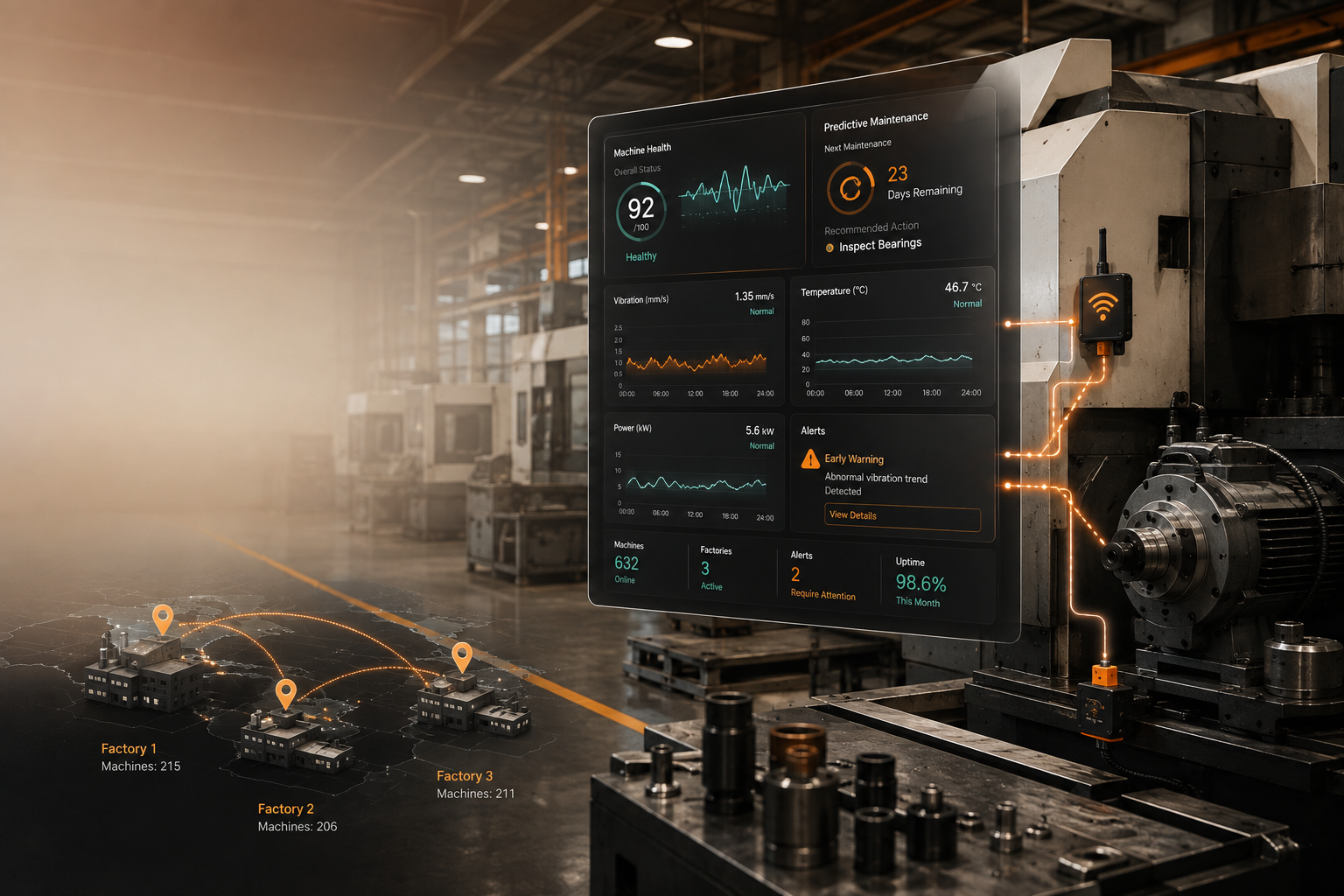
We started on the factory floor, literally — walking each production line with maintenance staff to understand which machines were the highest-value candidates for sensor retrofitting, since instrumenting all 600+ machines on day one wasn't realistic or necessary. Vibration, temperature, and power-draw sensors were fitted to priority machines first, streaming data over MQTT to a central ingestion pipeline.
That data feeds a predictive maintenance model trained specifically on Nordholt's own historical failure patterns rather than a generic industry model, since failure signatures genuinely differ by machine make, age, and workload. The model flags machines showing early signs of the wear patterns that have historically preceded failure, giving maintenance teams days or weeks of lead time instead of a floor manager discovering a stalled line.
Because any system touching German workforce data has to take GDPR seriously, we designed the shift-scheduling and maintenance-assignment features to anonymize or aggregate any employee-linked data at the point of collection wherever the analysis didn't actually require an individual identity — machine health monitoring almost never needs to know which specific technician was on shift, for instance.
We piloted the sensor retrofit and predictive model on a single production line for several weeks, comparing its predictions against what actually happened, before expanding to the other lines and eventually all three factories. That validation period mattered — it caught a few false-positive patterns in the early model that would have eroded trust with the maintenance team if they'd shown up during full rollout instead.
Move from calendar-based maintenance to data-driven, predictive scheduling.
Bring sensor data from all 3 factories into one central platform.
Give maintenance teams early warning instead of discovering failures after the fact.
Replace inconsistent paper logs with one digital system across all sites.
Early warning days or weeks before a machine would historically fail.
Real-time visibility into every instrumented machine across 3 factories.
Auto-generated maintenance work orders from predictive alerts.
Pattern detection across sites to catch recurring failure types.
Non-invasive sensor installation on existing machines.
Employee-linked data anonymized wherever identity isn't required.
We selected every technology based on this project's real requirements: compliance obligations, scalability needs, and long-term maintainability. No trend-chasing, only battle-tested solutions.
Agile delivery with regular demos and continuous deployment. Full transparency at every stage.
Walked each production line with maintenance staff to identify the highest-value machines for sensor retrofitting.
Fitted vibration, temperature, and power-draw sensors to priority machines without halting production.
Built the MQTT-to-cloud ingestion pipeline feeding a central time-series database.
Trained the failure-prediction model on Nordholt's own historical maintenance and failure records.
Validated model predictions against real outcomes on a single line for several weeks before expanding.
Expanded sensor coverage and the predictive model to all production lines at all 3 sites.
Numbers measured at 6 months post-launch, independently verified by the client's operations team.
| Before | After |
|---|---|
| Fixed-interval maintenance regardless of wear | Predictive, data-driven maintenance scheduling |
| No cross-factory machine health visibility | Central dashboard covering all 3 sites |
| Paper-based maintenance logs | Digital work orders with full history |
| Failures discovered after the line stopped | Early-warning alerts days or weeks ahead |
Beyond the numbers: what this project changed day-to-day for Nordholt Manufacturing GmbH and the people who rely on what we built.
Kawach Technology helps startups and enterprises build scalable, secure, and high-performance digital platforms. Let's turn your vision into the next success story.
Want a similar result for your business? Explore our Enterprise Software Development services, see our Manufacturing Software Development work , or see how we work with businesses in Germany , or get in touch directly.