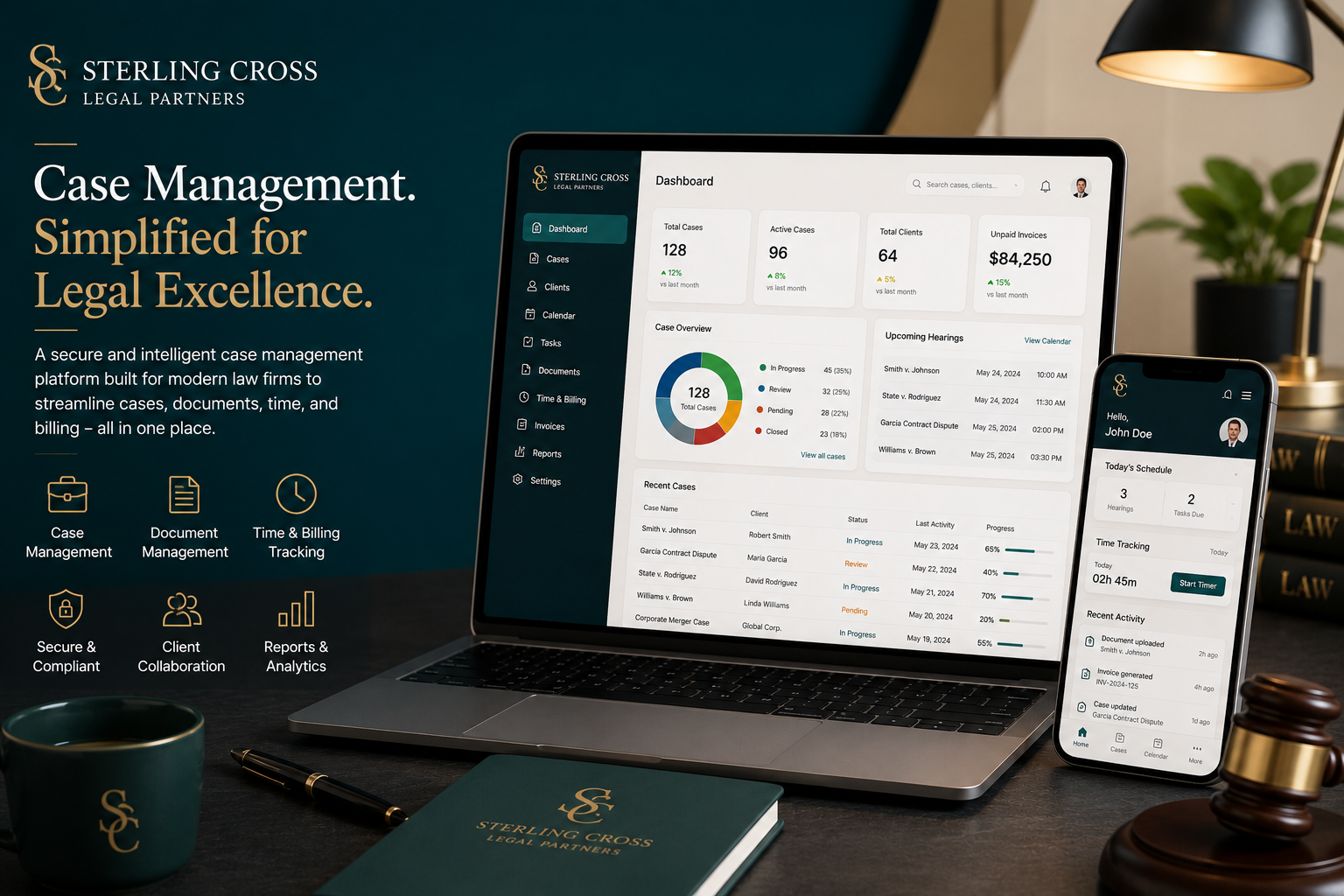
How Kawach Technology built a centralized case management platform for Sterling & Cross Legal Partners, cutting billing cycle time 60% across 5 offices.
Sterling & Cross Legal Partners has 140 attorneys spread across five U.S. offices, and until recently, "where is the file for this case" didn't have a reliable answer. Case documents were scattered across shared network drives, email threads, and individual attorneys' personal folders — a filing system that worked well enough for any one attorney's own matters but fell apart the moment a case...
Sterling & Cross Legal Partners has 140 attorneys spread across five U.S. offices, and until recently, "where is the file for this case" didn't have a reliable answer. Case documents were scattered across shared network drives, email threads, and individual attorneys' personal folders — a filing system that worked well enough for any one attorney's own matters but fell apart the moment a case needed input from colleagues in another office.
Billing was tracked in spreadsheets attorney by attorney, which meant reconstructing a single client's monthly bill could take days of cross-referencing multiple people's records. Conflict-of-interest checks — a genuinely serious obligation before accepting any new client — were done manually, with staff searching old files and asking around the office, an approach that scales badly and carries real risk of missing something.
Day-to-day collaboration had its own friction: multiple attorneys editing the same document via shared drives led to constant version confusion, and more than once, real edits were lost when two people saved over each other's work. And because none of this generated structured data, partners had no consolidated view of case status or associate workload across the firm — decisions about staffing and case assignment were made on incomplete information.
We began with practice-group-level discovery across all five offices, since litigation, M&A, and IP practice groups each organized their case files quite differently — a single rigid taxonomy would have satisfied none of them. What we built instead was a centralized case repository with a flexible-but-structured filing convention, backed by real document version control so simultaneous edits no longer meant a coin-flip on whose changes survived.
The conflict-of-interest database was one of the more sensitive pieces of this project: it needed to be searchable enough to genuinely catch potential conflicts, while respecting the ethical walls that must exist between attorneys working on adverse matters. We built role-based access controls specifically so a conflict search can confirm whether a name appears in the system without exposing the substantive contents of a screened-off matter to someone who shouldn't see it.
Time tracking and billing were automated by tying entries directly to case activity rather than relying on attorneys to reconstruct their day from memory at month's end — a change that alone cut billing cycle time by more than half. On top of all of this, we built a partner dashboard giving firm leadership a real-time view of case status and associate workload across all five offices, replacing what used to require calling each office manager individually.
We piloted the system with two practice groups before firm-wide rollout, deliberately choosing groups with different document-heavy workflows — litigation's discovery-document volume and M&A's contract-negotiation cycles are very different beasts, and the pilot surfaced workflow gaps in each that we could fix before all 140 attorneys were relying on the system.
Replace scattered drives and email with one searchable case repository.
Tie time entries directly to case activity instead of manual reconstruction.
Make conflict-of-interest checks searchable and auditable, not manual and ad hoc.
Show case status and associate workload across all 5 offices in real time.
One searchable home for every case file across all offices.
Real version history eliminating lost-edit conflicts.
Time entries generated from actual case activity.
Fast, auditable conflict checks respecting ethical walls.
Firm-wide case status and workload visibility.
A confidential channel for client document sharing.
We selected every technology based on this project's real requirements: compliance obligations, scalability needs, and long-term maintainability. No trend-chasing, only battle-tested solutions.
Agile delivery with regular demos and continuous deployment. Full transparency at every stage.
Studied how litigation, M&A, and IP practice groups organize case files differently across all 5 offices.
Designed a flexible-but-structured filing system with real version history.
Built a searchable conflict-of-interest system respecting ethical walls between screened matters.
Tied time entries directly to case activity to eliminate manual end-of-month reconstruction.
Tested the system with litigation and M&A groups, whose document workflows differ significantly.
Trained all 140 attorneys across 5 offices in role-specific sessions.
Numbers measured at 6 months post-launch, independently verified by the client's operations team.
| Before | After |
|---|---|
| Case files scattered across drives, email, and folders | One centralized, searchable case repository |
| Manual spreadsheet billing | Automated time tracking and invoicing |
| Days-long manual conflict checks | Searchable conflict database in minutes |
| No firm-wide case visibility | Partner dashboard across all 5 offices |
Beyond the numbers: what this project changed day-to-day for Sterling & Cross Legal Partners and the people who rely on what we built.
Kawach Technology helps startups and enterprises build scalable, secure, and high-performance digital platforms. Let's turn your vision into the next success story.
Want a similar result for your business? Explore our CRM Development services , or see how we work with businesses in the USA , or get in touch directly.