Giving SwiftCargo Logistics Real-Time Fleet Visibility with a Custom Shipment Tracking Platform Giving SwiftCargo Logistics Real-Time Fleet Visibility with a Custom Shipment Tracking Platform
1 0 1 1 0 0 1 0
0 1 0 0 1 1 0 1
1 1 0 1 0 1 1 0
0 0 1 0 1 0 0 1
Back to Case Studies
Case Study: Logistics & Supply Chain

Giving SwiftCargo Logistics Real-Time Fleet Visibility with a Custom Shipment Tracking Platform

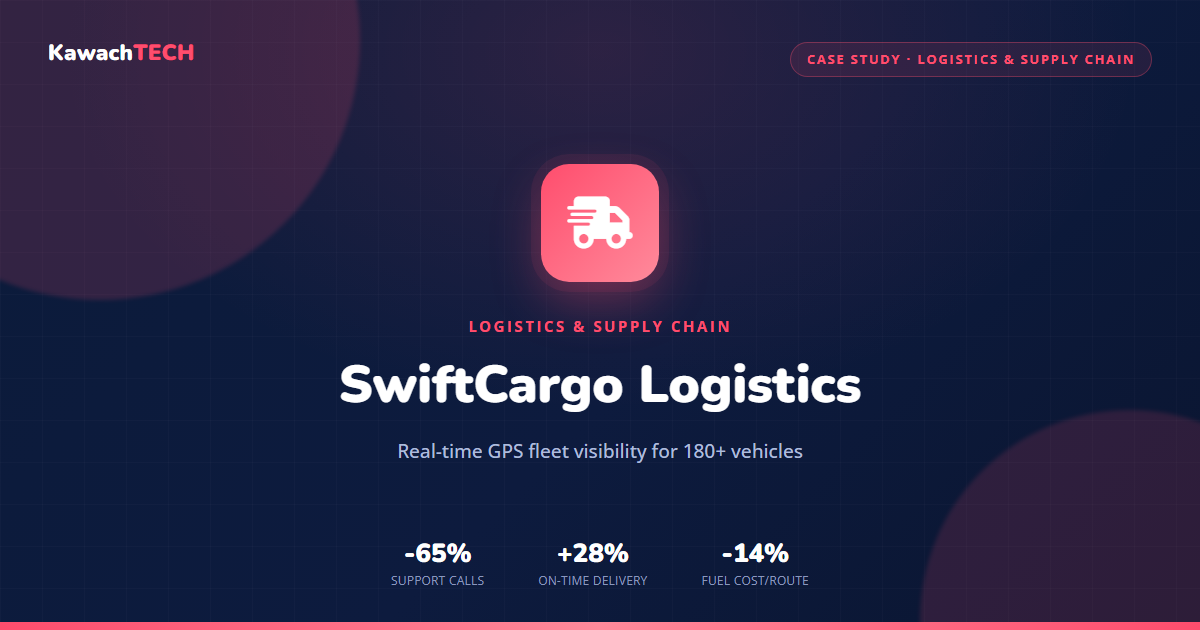
How Kawach Technology built a real-time GPS fleet tracking and shipment platform for SwiftCargo Logistics, cutting support calls by 65%.

Logistics & Supply Chain 8 months Aug 2025
Explore Project
-65%
Customer Support Calls
+28%
On-Time Delivery Rate
Days → Same-day
Invoicing Delay
-14%
Fuel Cost per Route

Client Overview

SwiftCargo Logistics

SwiftCargo Logistics runs a fleet of more than 180 vehicles across India, but for a company built on moving things reliably, they had remarkably little visibility into where those things actually were at any given moment. Dispatch planning happened entirely over phone calls and WhatsApp messages between the control room and individual drivers — functional, but with no central record anyone could r...

Industry
Logistics & Supply Chain · Logistics Software Development
Business Size
180+ vehicle fleet, pan-India operations
Location
Chennai, India
Business Model
B2B Freight & Logistics
Project Duration
8 months
Existing Challenges
  • Dispatch planning was coordinated entirely over phone calls and WhatsApp between the control room and 180+ drivers, with no central record.
  • Customers had no way to track their shipment and called support multiple times per shipment for status updates.
  • Delivery proof (signed receipts) was collected on paper and only reached the office days after delivery, delaying invoicing.
  • Route planning was left to individual driver judgment, leading to inconsistent fuel costs and delivery times across similar routes.
  • There was no historical data to identify recurring delays, problem routes, or underperforming vehicles.
The Challenge

What We Were Up Against

SwiftCargo Logistics runs a fleet of more than 180 vehicles across India, but for a company built on moving things reliably, they had remarkably little visibility into where those things actually were at any given moment. Dispatch planning happened entirely over phone calls and WhatsApp messages between the control room and individual drivers — functional, but with no central record anyone could refer back to.

Customers felt this gap directly: with no way to track their own shipment, they called the support team repeatedly for status updates on a single delivery, straining a support team that had no better answer than calling the driver themselves. Delivery proof — a signed receipt — was collected on paper and often didn't reach the office for days after the actual delivery, which delayed invoicing and, by extension, cash flow.

Route planning was left entirely to individual driver judgment, which meant fuel costs and delivery times varied inconsistently across routes that should have looked similar. And because none of this generated structured data, SwiftCargo had no way to identify recurring delays, chronically problematic routes, or underperforming vehicles — the kind of patterns that, once visible, are usually the easiest problems to fix.

Our Solution

How We Built It

We spent time directly in SwiftCargo's control room and rode along with drivers on actual delivery runs before designing anything — the goal was to understand dispatch and delivery exactly as it happened, not as an org chart described it. One early, practical decision came out of that time: rather than requiring a costly fleet-wide hardware swap, we integrated directly with the GPS devices SwiftCargo already had installed in most vehicles.

The platform we built gives the control room live GPS tracking across the entire fleet, gives customers a self-service tracking link for their own shipments, and gives drivers a lightweight Flutter mobile app for status updates and digital proof-of-delivery capture — photo and e-signature, synced instantly rather than sitting in a driver's bag for days. A route optimization engine layers Google's traffic and directions data on top of SwiftCargo's own historical delivery times to suggest better routes.

We built the fleet tracking dashboard and customer tracking portal first, since dispatch visibility was the most urgent pain point, then piloted the driver app with a group of 20 drivers on a single route before expanding further. That pilot mattered — driver feedback led us to simplify the app's interface twice before it was ready for the remaining 160+ drivers, who we onboarded in batches over six weeks with in-person training at each depot.

The route optimization model kept improving after launch too: we spent two months tuning it against real delivery data before it consistently outperformed driver-only route judgment.

Key Modules Delivered
GPS Fleet Tracking
Live location tracking for all 180+ vehicles, visible on a control-room dashboard.
Customer Tracking Portal
A public tracking link customers use to see real-time shipment status without calling support.
Driver Mobile App
A lightweight Android/iOS app for drivers to update delivery status and capture digital proof of delivery.
Route Optimization
Suggests optimized delivery routes based on traffic, distance, and historical delivery time data.
Digital Proof of Delivery
Photo and e-signature capture at the point of delivery, synced instantly to the office for same-day invoicing.
Analytics Dashboard
Historical reporting on delivery times, fuel usage, and vehicle performance to spot recurring problem routes.
Goals & Objectives

What Success Looked Like

Real-Time Shipment Visibility

Give both the control room and customers live GPS tracking for every shipment in transit.

Reduce Support Load

Let customers self-serve shipment status instead of calling in for updates.

Digitize Proof of Delivery

Capture signed delivery confirmation instantly through a driver mobile app.

Optimize Routes & Fuel Costs

Use data-driven route suggestions to cut fuel consumption and delivery times.

Features Developed

What We Built

Live GPS Fleet Tracking

Real-time location visibility for the entire 180+ vehicle fleet.

Customer Tracking Portal

Self-service shipment tracking with no login required.

Digital Proof of Delivery

Photo and e-signature capture synced instantly to the office.

Route Optimization

Data-driven route suggestions to cut fuel costs and delays.

Fleet Analytics Dashboard

Historical insights into delivery performance and vehicle usage.

Technology Stack

Built With the Right Tools

We selected every technology based on this project's real requirements: compliance obligations, scalability needs, and long-term maintainability. No trend-chasing, only battle-tested solutions.

Backend
Laravel 10 PHP 8.2 PostgreSQL
Driver Mobile App
Flutter MQTT (real-time location updates)
Mapping & Routing
Google Maps API Google Directions API
Infrastructure
AWS EC2 RDS IoT Core (GPS device ingestion)
Development Process

How We Delivered It

Agile delivery with regular demos and continuous deployment. Full transparency at every stage.

Total Timeline
8 months
Started → Ongoing
1
01
Control Room & Driver Discovery

Spent time in SwiftCargo's control room and rode along with drivers to understand real dispatch and delivery workflows.

2
02
GPS Hardware Integration Planning

Evaluated and integrated with SwiftCargo's existing in-vehicle GPS devices instead of requiring a costly hardware swap.

3
03
Core Tracking Platform Build

Built the fleet tracking dashboard and customer tracking portal first, since dispatch visibility was the most urgent pain point.

4
04
Driver App Pilot

Piloted the driver mobile app with a group of 20 drivers on one route before rolling it out fleet-wide.

5
05
Fleet-Wide Rollout

Onboarded the remaining 160+ drivers in batches over 6 weeks, with in-person app training at each depot.

6
06
Route Optimization Tuning

Refined the route optimization model over 2 months using real delivery data to improve its suggestions.

Security & Compliance

Built for the Strictest Standards

Driver Data Privacy
Location tracking is limited to on-duty hours and used strictly for dispatch and delivery purposes.
Customer Data Protection
Shipment tracking links expose only shipment status to customers — no access to other customers' data or internal operational details.
Results / KPIs

Measurable Impact

Numbers measured at 6 months post-launch, independently verified by the client's operations team.

-65%
Customer Support Calls
+28%
On-Time Delivery Rate
Days → Same-day
Invoicing Delay
-14%
Fuel Cost per Route

Before vs. After

Before After
Dispatch coordinated over phone calls and WhatsAppCentralized dispatch dashboard with live GPS tracking
Customers called repeatedly for shipment statusCustomers self-track shipments via a live tracking link
Paper delivery receipts reaching office days laterDigital proof of delivery synced instantly, same-day invoicing
Route planning left to individual driver judgmentData-driven route suggestions cutting fuel costs by 14%
"
We were flying blind before this — a shipment left the depot and we genuinely didn't know where it was until the driver called in or the customer complained. Now our control room sees every vehicle in real time, customers track their own shipments, and we invoice the same day instead of waiting on paper receipts to arrive. It's completely changed how we operate.
KA
Karthik Subramaniam
Head of Operations, SwiftCargo Logistics
★★★★★
Key Achievements

Why This Project Matters

Beyond the numbers: what this project changed day-to-day for SwiftCargo Logistics and the people who rely on what we built.

65% Fewer Support Calls Within First Quarter
Customer-initiated status check calls dropped by 65% once the self-service tracking portal launched.
Same-Day Invoicing Became Possible
Digital proof of delivery let SwiftCargo's finance team start invoicing the same day a shipment was delivered, instead of waiting days for paper receipts.
28% Improvement in On-Time Delivery
Route optimization and better dispatch visibility lifted the on-time delivery rate by 28% within 4 months of full rollout.
FAQ

Common Questions

Have more questions? Book a call with our team.

Did SwiftCargo need to install new GPS hardware in their vehicles?
No. We integrated directly with the GPS devices already installed across the fleet, which avoided a costly and time-consuming hardware replacement.
How do customers access shipment tracking?
Each shipment gets a unique tracking link sent via SMS/email — customers open it directly in their browser with no account or app download required.
How was the driver app adopted across 180+ drivers with varying smartphone comfort levels?
We piloted the app with 20 drivers first, simplified the interface based on their feedback, then rolled it out fleet-wide in batches with in-person training at each depot.
Does the route optimization account for real-world traffic conditions?
Yes — it factors in live traffic data from the Google Directions API alongside SwiftCargo's own historical delivery time data for each route.
Related Case Studies

More Success Stories

Ready to Get Started?

Looking for Custom Logistics & Supply Chain Software Development?

Kawach Technology helps startups and enterprises build scalable, secure, and high-performance digital platforms. Let's turn your vision into the next success story.

View All Case Studies

Want a similar result for your business? Explore our ERP Development services, see our Logistics Software Development work , or get in touch directly.